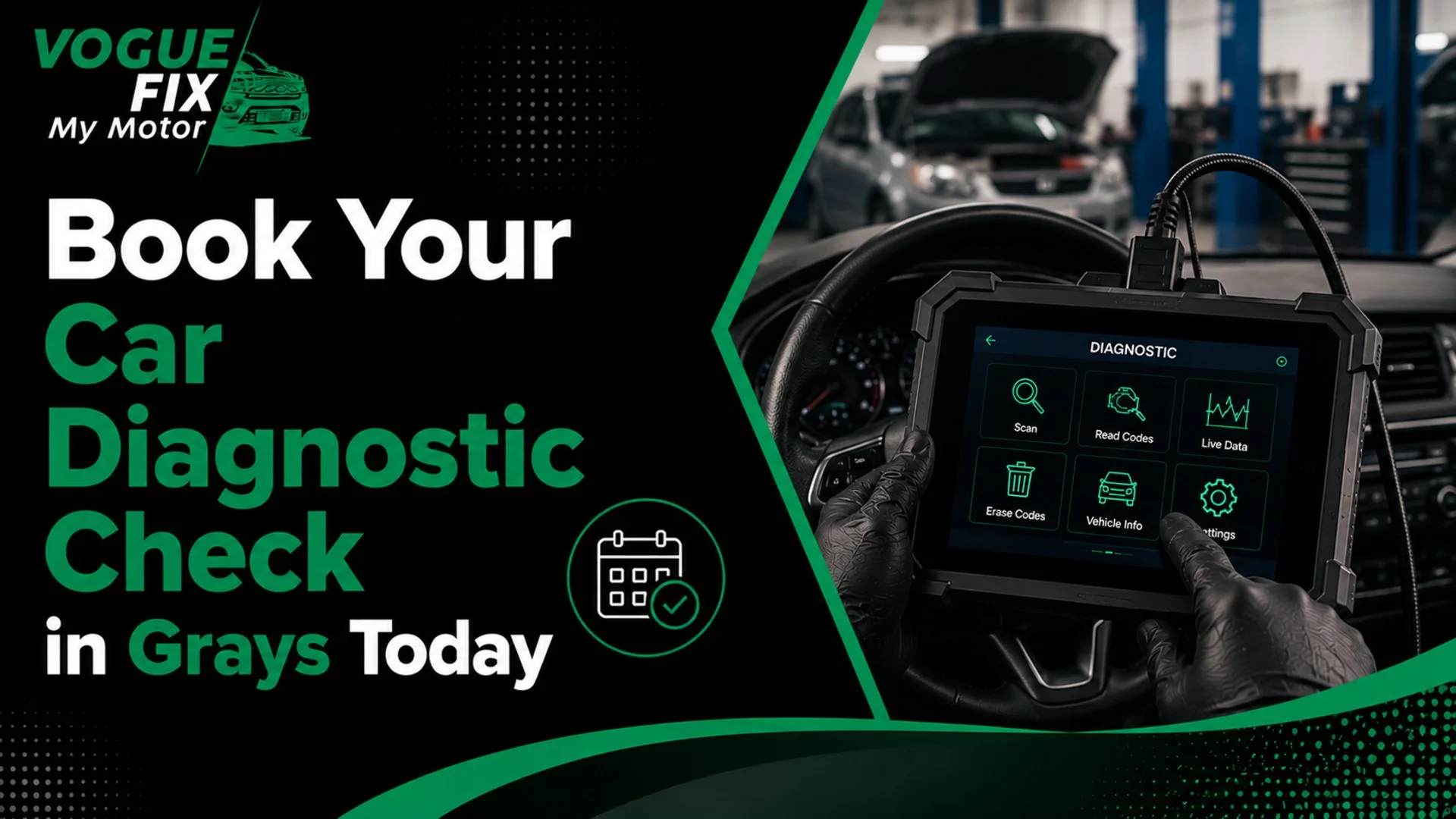
Car Diagnostic Check Grays | Expert Vehicle Diagnostics by Vogue Fix My Motor
Your dashboard just lit up. Maybe it's the check engine light, maybe it's a warning symbol you've never seen before, and now you're wondering whether it's something serious or something you can ignore until next week.
Your dashboard just lit up. Maybe it's the check engine light, maybe it's a warning symbol you've never seen before, and now you're wondering whether it's something serious or something you can ignore until next week. That uncertainty is exactly why a proper car diagnostic check exists, and it's why so many drivers across Grays end up searching for answers at the worst possible time, usually on the side of the road or five minutes before a school run.
At Vogue Fix My Motor, we see this every week. A warning light appears, the car still drives "fine," and the temptation is to wait it out. Sometimes that's harmless. Sometimes it's the difference between a £60 sensor replacement and a £600 engine repair. The only way to know which one you're dealing with is a proper diagnostic check, not a guess, not a quick look under the bonnet, but an actual scan of your vehicle's onboard computer.
This guide walks through exactly what a car diagnostic check involves, the warning signs that mean you shouldn't wait, and why drivers across Grays, Thurrock, and the wider Essex area trust us to get it right the first time.
What Is a Car Diagnostic Check?
A car diagnostic check is a process where a technician connects a diagnostic scanner to your vehicle's onboard computer system to read fault codes, monitor live sensor data, and identify exactly what's causing a warning light, performance issue, or unusual noise. It's the modern equivalent of a doctor running blood tests instead of guessing based on symptoms alone.
Every car built since the mid-1990s carries an OBD-II (On-Board Diagnostics) port, which connects to the vehicle's ECU, the Engine Control Unit, sometimes also called the ECM or PCM depending on the manufacturer. This onboard computer constantly monitors dozens of systems: engine performance, emissions, transmission behaviour, braking systems, and more. When something falls outside normal parameters, it stores a Diagnostic Trouble Code (DTC) and often triggers a dashboard warning light.
How Does Vehicle Diagnostics Work?
The process is more thorough than most drivers expect. Here's what actually happens during a diagnostic session:
Scanner connection – A professional-grade scanner (we use Autel and Launch diagnostic tools) plugs into the OBD-II port and communicates directly with the ECU via the CAN bus network.
Fault code retrieval – The scanner pulls every stored trouble code, not just the one triggering the current warning light.
Live data analysis – Rather than relying on stored codes alone, our technicians review real-time sensor readings, oxygen sensor output, fuel trims, coolant temperature, and more, while the engine runs.
Interpretation – This is where experience matters most. A fault code points to a system, not always the exact part. Reading live data and cross-referencing symptoms is what separates an accurate diagnosis from a guess.
Reporting – You get a clear explanation of what's wrong, what caused it, and what it will take to fix it.
This last step matters more than most garages admit. A diagnostic report full of codes means nothing to most drivers. We translate it into plain English before we recommend any work.
What Does Our Diagnostic Check Include?
Every diagnostic check we carry out in Grays covers the full picture, not just the single fault that triggered your warning light.
OBD-II & ECU Scanning Explained
Our scan reads data across all connected modules, engine, transmission, ABS, airbag, and body control systems where applicable. This matters because a single underlying issue, such as a failing battery or a wiring fault, can trigger warning signs across multiple systems at once. Scanning only the engine module would miss that connection entirely.
We also check for pending codes, faults that haven't yet triggered a warning light but are building toward one. Catching these early is often the difference between a simple fix and a breakdown.
What Diagnostics Can (and Can't) Detect
It's worth being honest about the limits here, because plenty of drivers assume diagnostics catch everything.
Intermittent faults that aren't present at the exact time of scanning
Physical damage that hasn't yet triggered a sensor reading
This is why a diagnostic scan is often paired with a physical inspection, the code tells us where to look, but a trained eye confirms the actual cause.
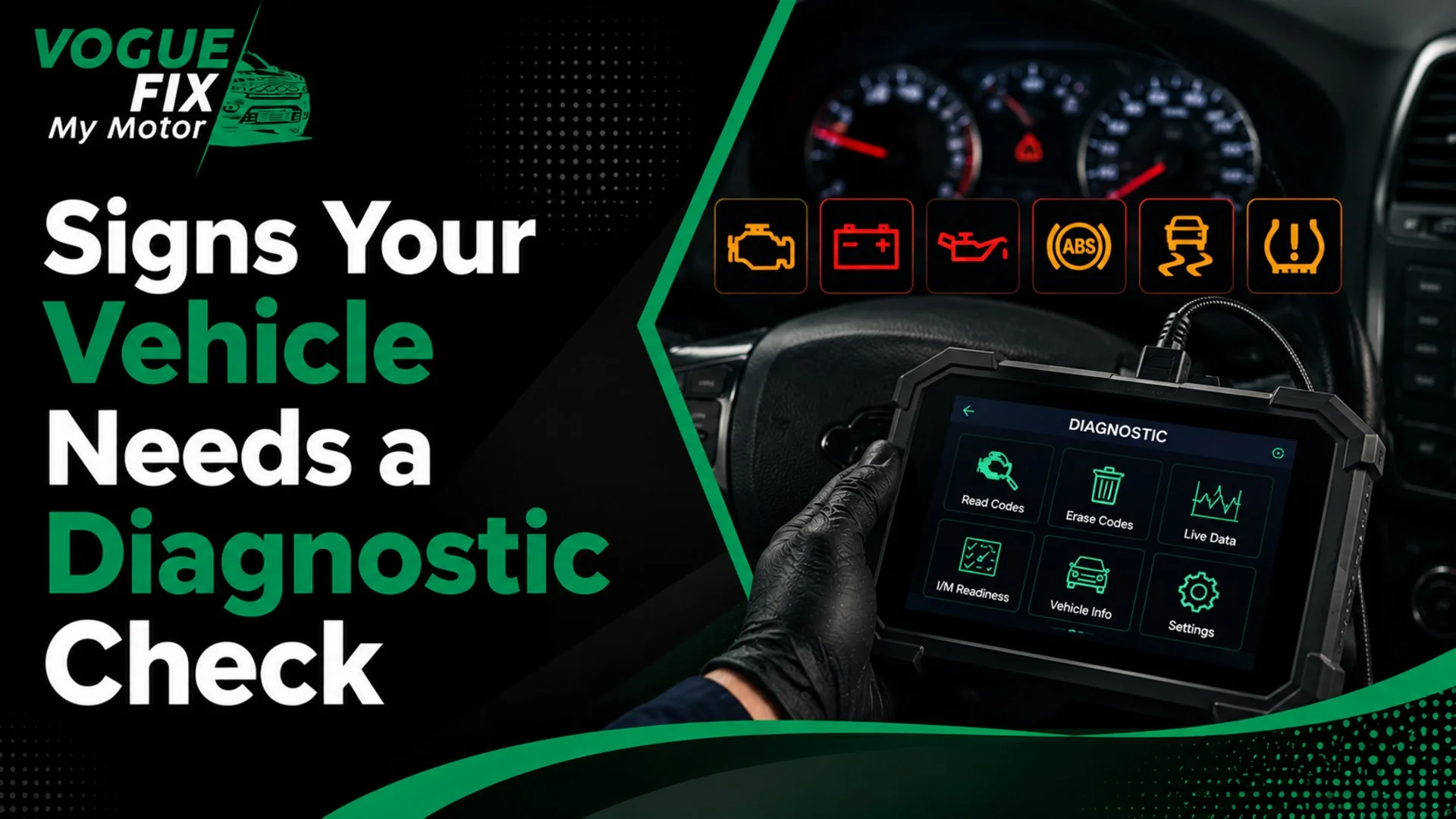
Signs Your Vehicle Needs a Diagnostic Check
Most drivers wait too long before booking a diagnostic check, usually because the car still "seems to run okay." The problem is that engine management systems are designed to protect the engine, not maximise performance, so by the time you notice a real difference in how the car drives, the underlying fault may have been building for weeks.
Common Dashboard Warning Lights We Diagnose
Engine Management (Check Engine) Light
This is the most common reason drivers in Grays book a diagnostic check with us, and it's also the most misunderstood. The engine management light can mean anything from a loose fuel cap to a serious misfire. Common causes we see include faulty oxygen sensors, MAF sensor contamination, ignition coil failure, and fuel injection faults. Ignoring it doesn't just risk a bigger repair bill, a sustained misfire can damage your catalytic converter, turning a £100 fix into a £600 one.
ABS, Airbag & Battery Warning Lights
An ABS warning light usually points to a sensor fault within the braking system, often a wheel speed sensor affected by dirt, damage, or wiring corrosion. Airbag faults are almost always electrical, a seat sensor, connector, or wiring issue rather than the airbag unit itself. A battery light, meanwhile, often signals a charging system problem with the alternator rather than the battery itself, which is exactly why diagnostics matter, replacing the wrong part fixes nothing.
Common Faults Identified Through Diagnostics
Misfires, Rough Idle & Poor Fuel Economy
If your car has developed a rough idle, hesitates on acceleration, or you've noticed your fuel economy dropping without an obvious reason, these are classic symptoms that live diagnostic data can pinpoint quickly. We regularly trace these symptoms back to worn spark plugs, failing ignition coils, vacuum leaks, or fuel injector faults, all of which show up clearly once we're looking at live sensor readings rather than guessing.
Other warning signs worth booking a check for include limp mode activation, unexplained overheating, a car that struggles to start, or unusual engine noise that wasn't there last month. None of these should wait for your next scheduled service.
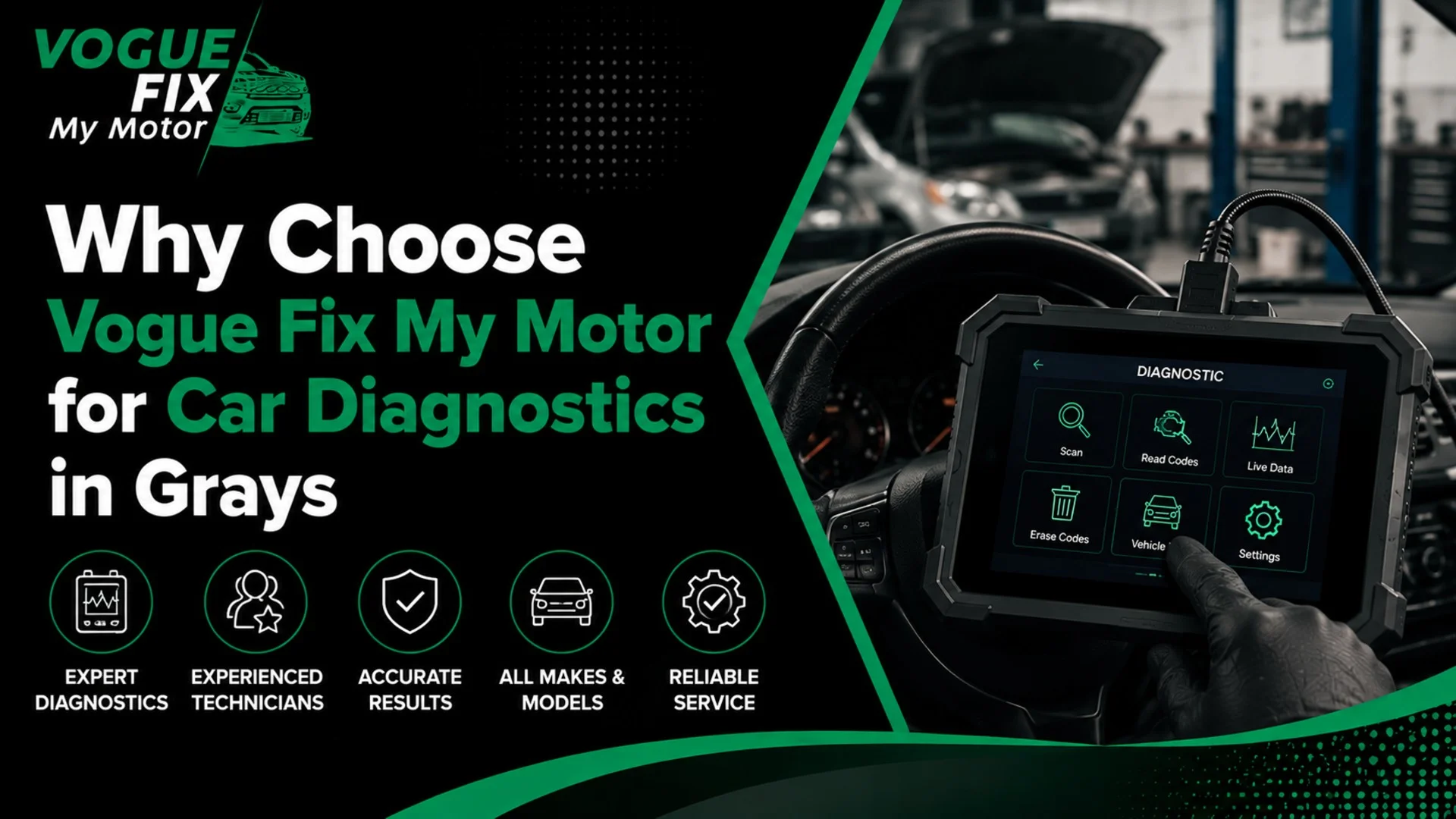
Why Choose Vogue Fix My Motor for Car Diagnostics in Grays
There's no shortage of garages offering diagnostic services across Grays, Thurrock, and Essex. What separates a genuinely useful diagnostic check from a box-ticking exercise comes down to three things: the equipment used, the experience interpreting the results, and honesty about what actually needs fixing.
Diagnostic Equipment & Technology We Use
We invest in professional-grade diagnostic scanners, including Autel and Launch tools, rather than the basic code readers found in many budget garages. The difference matters. Entry-level scanners often only read generic codes and miss manufacturer-specific fault data, live sensor streams, and module-level detail across ABS, airbag, and transmission systems. Our equipment reads the full picture, which means fewer follow-up visits and more accurate first-time diagnosis.
All Makes, Models & Fuel Types Covered
Whether you're driving a small city runaround or a larger family SUV, our diagnostic service covers all makes and models, not just a handful of manufacturers.
Petrol, Diesel & Hybrid Diagnostics
Diesel engines bring their own diagnostic challenges, particularly around DPF blockages, EGR valve faults, and turbo actuator issues that petrol engines simply don't experience in the same way. Petrol engines more commonly show ignition and fuel injection faults. Hybrid vehicles add another layer entirely, with battery management systems and hybrid control modules that require specific diagnostic knowledge to interpret correctly. We're equipped to handle all three, so you're not turned away or referred elsewhere based on what's under your bonnet.
Transparent Pricing, Honest Advice & Fast Turnaround
One of the most common frustrations drivers mention to us is being quoted vague costs or being told they need work that turns out to be unnecessary. We provide clear, upfront pricing before any work begins, explain exactly what a fault code means in plain terms, and only recommend repairs that are actually needed. If a warning light turns out to be something minor, we'll tell you, even if that means a shorter invoice.
Here's a simple comparison of what to expect from a proper diagnostic check versus a basic code read:
What You Get
Basic Code Reader Check
Full Diagnostic Check (Vogue Fix My Motor)
Fault code retrieval
Yes, generic codes only
Yes, including manufacturer-specific codes
Live sensor data analysis
No
Yes
Multi-system scan (ABS, airbag, transmission)
Rarely
Yes
Plain-English explanation
Rarely
Always
Repair recommendation accuracy
Limited
High
Follow-up visits needed
Common
Rare
Book Your Car Diagnostic Check in Grays Today
A dashboard warning light rarely fixes itself, and waiting usually costs more than acting early. If your check engine light is on, your car feels off, or you simply want peace of mind before a longer journey or an MOT, booking a diagnostic check is the fastest way to get a straight answer instead of a guess.
Frequently Asked Questions
What does a diagnostic check include?
A full diagnostic check includes an OBD-II scan of your vehicle's ECU, live sensor data analysis, and a review of fault codes across relevant systems such as engine, ABS, and transmission, followed by a plain-English explanation of what's wrong and what it will take to fix it.
How Much Does a Car Diagnostic Check Cost?
Diagnostic costs vary depending on the complexity of the fault and the systems involved, but we provide a clear quote before starting any work, so there are no surprises on your invoice. Contact us directly for a same-day quote based on your specific vehicle and symptoms.
How long does vehicle diagnostics take?
A standard diagnostic scan typically takes between 30 minutes and an hour, though intermittent faults or complex live data analysis can take longer to isolate accurately.
Can diagnostics detect engine problems before they get worse?
Yes. Diagnostics often pick up pending fault codes before a warning light even appears, which is one of the strongest reasons to book a check at the first sign of unusual behaviour rather than waiting for a breakdown.
Is an OBD scan accurate on its own?
An OBD scan reliably identifies stored fault codes, but accurate diagnosis usually requires interpreting that data alongside live readings and, in some cases, a physical inspection, which is why experience matters as much as the equipment itself.
Do diagnostics identify battery and charging problems?
Yes. A diagnostic check can distinguish between a failing battery and a faulty alternator or charging system fault, which prevents drivers from replacing the wrong part.
Areas We Cover Across Grays, Thurrock & Essex
We provide car diagnostic checks and full diagnostic repair services across Grays and the surrounding areas, including Thurrock, Tilbury, Purfleet, Stanford-le-Hope, Corringham, and South Ockendon. Wherever you're based locally, our team is set up to get you booked in quickly, often with same-day availability for urgent warning light diagnosis.
If your dashboard warning light has been on for more than a day or two, don't wait for it to become a bigger problem. Book your car diagnostic check with Vogue Fix My Motor today and get a clear, honest answer about what's really going on under the bonnet, backed by proper equipment, experienced technicians, and pricing you can trust before any work begins.