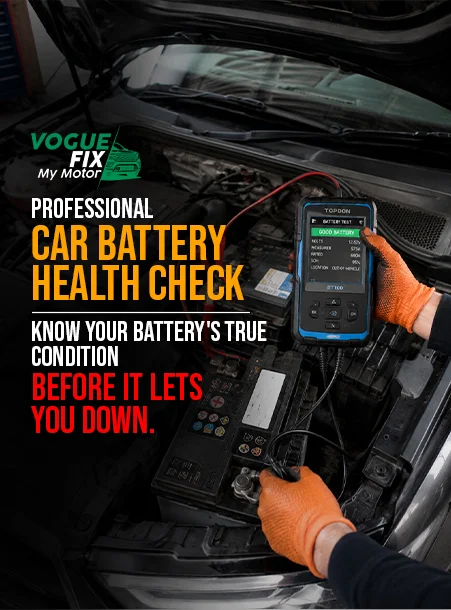
Professional Car Battery Health Check, Know Your Battery's True Condition Before It Lets You Down
There's a certain confidence that comes from knowing your car battery is genuinely healthy, not just charged, but truly capable of delivering reliable power through cold winter mornings, motorway trips, and the unpredictable demands of daily UK driving.
There's a certain confidence that comes from knowing your car battery is genuinely healthy, not just charged, but truly capable of delivering reliable power through cold winter mornings, motorway trips, and the unpredictable demands of daily UK driving. At Vogue Fix My Motor, we carry out professional car battery health checks that go far beyond the surface-level readings you get at a petrol station forecourt. What we provide is diagnostic certainty, the kind that protects your vehicle, your wallet, and your peace of mind.
Whether you drive a conventional petrol or diesel vehicle, a fully electric car, or a hybrid model, battery degradation is a reality every driver must face. The question isn't whether your battery will lose capacity over time, it will. The real question is: do you know where it stands right now?
What Does a Car Battery Health Check Actually Involve?
A proper car battery health check isn't simply plugging in a device and reading a voltage number. Voltage alone tells you very little. A battery sitting at 12.6 volts can still fail under load, and load performance is precisely what matters when you turn your ignition key on a January morning. Our diagnostic process evaluates cold cranking amps (CCA), state of charge (SoC), state of health (SoH), and internal resistance, the four pillars of a complete and honest battery assessment.
Is Checking Car Battery Health the Same as a Simple Voltage Test?
Not at all, and this is one of the most common misconceptions we encounter. A voltage test is the equivalent of checking whether a glass has water in it without knowing whether that water is clean, warm, or about to run out. Properly checking car battery health requires a load test or conductance test that simulates real-world demand on the battery. Our technicians use professional-grade diagnostic equipment to perform a complete assessment that no multimeter at home can fully replicate.
How to Check Car Battery Health With a Multimeter at Home
If you want to check your car battery health at home as a basic starting point, a digital multimeter is a useful tool, but its limitations matter. Set your multimeter to DC voltage at the 20V range. With the engine off and all electrics switched off, place the red probe on the positive terminal and the black probe on the negative. A fully charged, healthy 12V battery should read between 12.6V and 12.8V. A reading below 12.4V suggests the battery needs attention; below 12.0V and you're dealing with a battery that's significantly discharged or degraded.
Can You Check Car Battery Health With a Multimeter and Internal Resistance Reading?
Standard multimeters cannot measure internal resistance, you'd need a dedicated battery analyser for that. Internal resistance is one of the most revealing indicators of battery health: as a battery ages and its cells degrade, internal resistance rises, meaning it delivers power less efficiently under load. This is why home multimeter checks, while better than nothing, aren't a substitute for a professional car battery health check. If your battery shows borderline readings at home, book a diagnostic with us, the difference in insight is substantial.
What's the Best Way to Check Car Battery Health Accurately?
The best way to check car battery health accurately is through a professional diagnostic service using conductance testing technology, the industry gold standard. Unlike basic load testers, conductance analysers send a small signal through the battery and measure its response, providing precise SoH and CCA values without putting unnecessary strain on the battery. Every battery health check we perform uses this method, and every result comes with a clear, jargon-free report so you know exactly where you stand.
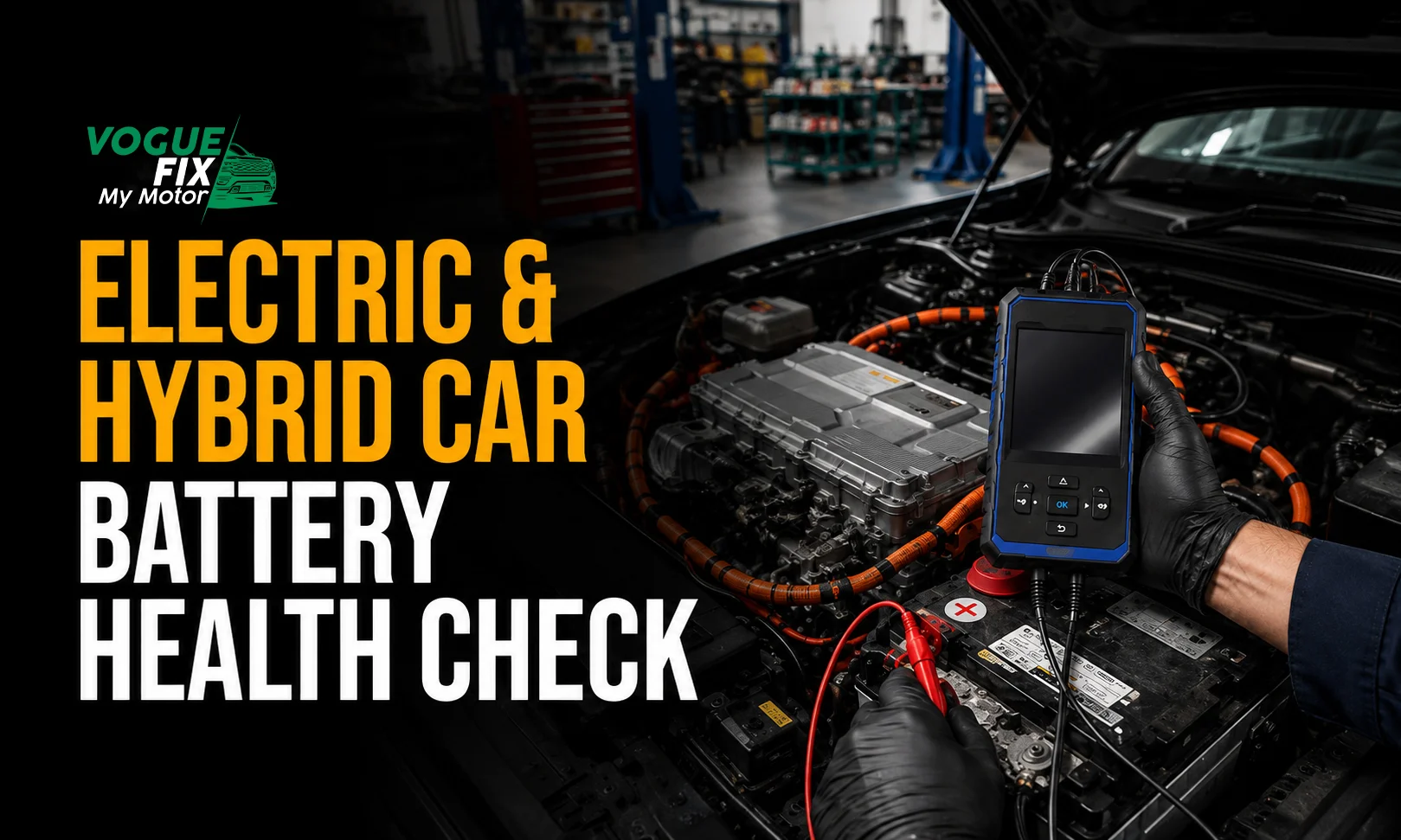
Electric & Hybrid Car Battery Health Check
Battery health in an electric or hybrid vehicle is an entirely different matter to a conventional 12V starter battery. The high-voltage traction battery that powers your EV, or assists your hybrid's combustion engine, degrades differently, costs significantly more to replace, and directly affects your vehicle's resale value. A battery health check for your electric or hybrid car isn't merely routine maintenance, it's a financial imperative.
How to Check Electric Car Battery Health the Right Way
Checking electric car battery health properly requires specialist diagnostic software that communicates directly with the vehicle's Battery Management System (BMS). The BMS logs critical data including state of health, degradation percentage, charge cycles, and cell-level balance information. Consumer apps, such as those for Nissan LEAF or Renault Zoe owners, offer a useful overview, but they don't replace the depth of analysis a qualified EV technician can extract from a full diagnostic session.
How to Check EV Car Battery Health and What the Results Mean
When we carry out an EV battery health check, we extract data that translates directly into meaningful conclusions for you as a driver or seller. A state of health reading above 80% is generally considered strong; between 70% and 80% indicates noticeable degradation worth documenting; below 70% and your driving range and resale value are meaningfully impacted. Understanding these numbers, and having them certified, gives you negotiating power whether you're buying, selling, or simply maintaining your EV.
How to Check Hybrid Car Battery Health on Popular Models
Hybrid battery health checks are particularly relevant for Toyota Prius, Honda Jazz Hybrid, Lexus CT200h, and the growing number of plug-in hybrid models now on UK roads. These vehicles use nickel-metal hydride (NiMH) or lithium-ion packs that degrade gradually, often without obvious symptoms until performance drops noticeably. We work with all major hybrid platforms, and our diagnostics identify weak cell groups, abnormal temperature patterns, and balancing issues before they develop into costly failures.
How to Check Battery Health on a Hybrid Car vs a Full EV
The core diagnostic approach is similar, but the context differs. In a full EV, the traction battery is everything, it's the sole source of propulsion, and its health determines your usable range directly. In a hybrid, the battery works alongside a combustion engine, so degradation is often less immediately obvious but still materially affects fuel economy and emissions performance. Both require specialist equipment and expertise; neither should be assessed with a generic 12V battery tester.
How to Check Tesla Battery Health In-Car and Through Diagnostics
Tesla owners can access a basic battery health indicator directly through the vehicle's touchscreen by navigating to Controls > Service > Battery & Charging. However, Tesla's in-car display shows rated range rather than a true SoH percentage, which can be misleading. Third-party apps such as TeslaFi and Stats for Tesla offer more granular historical data, but a professional EV diagnostic session with us provides the most complete and certified picture of your Tesla battery's condition, essential if you're preparing for a private sale or part-exchange.
Why Book a Car Battery Health Check With Vogue Fix My Motor.co.uk?
There's no shortage of garages in the UK offering battery checks, but there's a meaningful difference between a cursory test carried out as an afterthought and a dedicated diagnostic service run by technicians who specialise in vehicle electrics and EV systems. We were built on a single principle: drivers deserve honest, expert assessments not upselling disguised as diagnostics.
Where Can I Check My Car Battery Health in the UK?
We operate across the United Kingdom, offering both in-workshop assessments and, for qualifying areas, mobile diagnostic visits. Whether you're based in London, Manchester, Birmingham, Leeds, or anywhere in between, our team is reachable and our booking process takes minutes. Simply visit our website, select your vehicle type, choose a convenient slot, and arrive knowing your car is in expert hands.
What Makes Vogue Fix My Motor.co.uk the Trusted Choice Across the United Kingdom?
Our reputation is built on three things: technical expertise, transparent reporting, and genuine respect for our customers' time and intelligence. We don't recommend battery replacements unless the data justifies it, and we don't use inflated industry jargon to obscure straightforward findings. Every battery health check report we issue is clear, detailed, and genuinely useful, whether you need it for your own records, a vehicle sale, or an insurance or warranty claim.
What Happens If My Battery Fails the Health Check?
If your battery doesn't meet the performance thresholds we assess against, we'll tell you clearly, explain exactly what the readings mean, and provide a cost recommendation for replacement or further investigation. We stock a wide range of OEM-compatible 12V batteries and have established relationships with leading EV battery refurbishment specialists across the UK. You'll never leave our service without a clear next step and a full understanding of your options.
What Are the Next Steps After a Failed Battery Test?
Once a fault or degradation is confirmed, we'll walk you through your options, repair, replacement, or, for EVs and hybrids, refurbishment, along with transparent pricing and timelines, so you can make a decision with full confidence and no pressure.
Do You Offer Replacement Batteries for All Vehicle Types?
Yes. From standard 12V starter batteries for petrol and diesel vehicles to high-voltage packs for EVs and hybrids, we source OEM-compatible replacements and work with trusted refurbishment partners to get you back on the road quickly and reliably.
Battery degradation doesn't announce itself with fanfare. It happens quietly, incrementally, until the morning it becomes an inconvenient or expensive problem. A professional car battery health check with Vogue Fix My Motor takes the guesswork away entirely, and given the cost of an unplanned roadside breakdown or a depleted EV battery discovered at point of sale, the value of that certainty is considerable.